Showing posts with label literature. Show all posts

Tuesday, October 13, 2009

Little Birds by Anaïs Nin

Since we've been a bit slow with posts recently, so I'm going to cross-post a very short review I just wrote on GoodReads of Anaïs Nin's Little Birds.

An interesting collection of very short erotic stories. I don't read very much erotica, so I can't compare this to anything, really, but it did certainly remind me of Memoirs of a Beatnik in many ways. Some of the writing is lovely, some is awful. The characters are mostly caricatures, but overall I liked it alright and was able to read the whole thing in just two hours. I suspect that if the stories individually and the book as a whole weren't so short, I might have grown bored. I'd really like to read Nin's journals now, because I suspect those will be a bit more substantive.

My recommendation to IttyBittyReaders: If you're in the mood for some very quick erotica, this might be a good place to start. If you're in the mood for a brilliant work of epic fiction, don't bother.

Tuesday, August 4, 2009

Infinite Jest


Okay so I finished IJ, and I don’t really want to get into it, but I am really glad I read it and am really into trying to get other people to read it. You can borrow my copy which originally came from Sarah. In fact, Sarah, I think you would like it, so do you want it back?

Since my original review, I moved away from the NY area and the activity of reading on public transit. This was the right condition to continue reading IJ! I made a lot of progress after I stopped lugging it around all the time. Though I did lug it through some airports and during my many mile (seemed like) walk that day in Madison round trip from W. Gilman to the end of Willy St., ending with many blisters and that familiar old sore shoulder.

There are so many little things I could mention about reading this book! Just doing a brief google search makes me want to re-read the whole thing. I think that’s an important point though – that you can read it as a Hamlet expert or a grammar/syntax expert, or maybe someone who has gone through AA or whatever, or you can just read it as someone whose friend gave them a copy one day without any prior knowledge about what is about to happen.

here are some interesting tips to prepare for reading -- not sure if this will encourage or discourage. The forward by Dave Eggers is also quite motivating -- it will make you feel like you are a part of something bigger than yourself by taking on this book.

"The older Mario gets, the more confused he gets about the fact that everyone at E.T.A. over the age of about Kent Blott finds stuff that's really real uncomfortable and they get embarrassed. It's like there's some rule that real stuff can only get mentioned if everybody rolls their eyes or laughs in a way that isn't happy." -- 529

Sunday, July 26, 2009

Barbara Kingsolver


I don't know how I ended up in love with Barbara Kingsolver. I distinctly remember telling someone that I wouldn't read The Poisonwood Bible because it was too commercial (it might have been the Oprah sticker, before I realized that Oprah's Book Club can be damn good). I really thought she was someone like Lauren Weisberger. Yet, somewhere along the line, I did read it, and I loved it. Loved it in a way that I could never have expected, and in a way I haven't loved very many books. It is one of those rare books that was both deeply moving and informational, and every moment of it was beautiful. If you haven't read it yet, please do. It's lovely.

So, finally realizing that Kingsolver wasn't quite as painfully commercial as I'd originally thought, I put her aside and didn't do much about it. Until I saw Animal, Vegetable, Miracle had come out. As you have probably guessed by reading this blog, I love food. In particular, I love ethical food. Though I was leaning more and more this way, reading this book just pushed me over the edge. Although I'm sure if I read Coming Home to Eat or In Defense of Food now, I'd love them and be inspired and moved, when I first read them, they didn't quite hit home. Animal, Vegetable, Miracle did, and I think I'd have to credit Kingsolver with most of my trips to the farmers' market and my whole garden experiment this year. It's a lovingly written, funny, and again, informational book. It also has some really good recipes, all of which you can check out on the website.

Several months later, bored and not sure what to read, I scanned my roommate's bookshelf and discovered The Bean Trees. Though I wouldn't say that Kingsolver's first novel is as good as The Poisonwood Bible, it was a very fast, moving read. It tells the story of a woman escaping her rural roots by moving out west. Along the way, she picks up a baby and meets some fascinating people. Again, it was less sophisticated than The Poisonwood Bible, both in style and content, but it was a good read, especially for the summer.

Then, two weeks ago, I passed a box of free books while walking down my block and, of course, grabbed a ton. Prodigal Summer was one of them, nestled among six Toni Morrisons and a Dave Eggers. I started reading it late last night, so I'm only a few pages in, but I'll keep you posted. In the meantime, I hope you grab one and let me know how you like it!

Sunday, July 19, 2009

A Book Review and an Apology


I want to take back my earlier invectives against the short story and recommend to you the book I finished most recently, Cosmicomics by Italo Calvino. It’s a pretty compact (approximately 150 pages) collection of short stories--12 in all. These are stories about the extinction of the dinosaur, the movement of the earth around the moon, the mollusk's shell, stories about atoms, matter, and the expansion of the universe. They are also stories about love, desire, embarrassment, longing. Each one is fiction, fiction grown out of a scientific fact or, perhaps, it is the other way around--perhaps it is the fiction-- the characters, the art--which give birth to the science and to the fact. Or maybe it is just that the two mingle and coil (so beautifully! so fantastically!) until it is impossible to distinguish one from the other. But, should they be distinguishable? Is it important to separate fact from fiction, science from art? Is it even possible?

This is something I think about a lot and I really don't know. I DO know, however, that this book is a real treat but if you’re looking to collect a lot of literary capital you might want to try Leah’s current friend: Infinite Jest by David Foster Wallace.

P.S. I just remembered another collection of short stories I love: Invisible Cities, also by Calvino.

Wednesday, July 1, 2009

The American Girls Cookbook

I love cooking. Unfortunately, I'm not so great at doing it myself (particularly when I come home from work), but I adore the concept. The whole process of it, from gardening to serving, enthralls me, and I want to participate in every part of it. I like to eat homemade meals and I love reading about other people cooking.

My parents weren't particularly big about cooking, and so I think my love of it came directly from one place, Pleasant Company. I have to say, they've sold out a lot recently, but back in the early 90s, they were just about the greatest thing ever, and I loved just about everything that came out of it. In particular, The American Girls Cookbook.

This book taught me a love for place settings (Samantha), deviled eggs (Molly) and saffron (a pretty enormous mistake with Kirsten). It also taught me the joys of reading about food, and is one of the few cookbooks that I've ever been able to follow perfectly. Perhaps now that I'm able to read books by Julia Child, Irma S. Rombauer and Alice Waters, I should move beyond this book, but it will always be the one that started a life-long love affair.

Wednesday, June 24, 2009

Reading Infinite Jest

I have been reading David Foster Wallace's Infinite Jest for about two weeks now. I am on page 156 out of 1079, including footnotes. The main thing that is tricky about reading is the book's size. I am used to carrying a book around to read while waiting for the G train and stuff, which is where I get most of my reading done. But even if my bag is empty except for this one book, the weight begins to feel like a burden after walking about two blocks with the thing hanging on my shoulder. At this point, my shoulder is actually sore, so the carrying of this books is becoming a bit of an ordeal.

Then there is actually trying to read the book. It is manageble to read while standing up, as if waiting for a train, for example, but I think there is nothing nerdier than holding your place on page 60 to flip the 1000+ pages to read a footnote about Monoamine-oxidase inhibitors (pg 994) (and struggling) in public. You begin to ask yourself, is it worth hefting this huge book out of my bag and finding my place to read only a few paragraphs (and probably getting a little confused...I find it hard to figure out what's going on if I start in the middle of section)? Also, you definitely need two hands to read the book, so if you are standing up on the subway, forget it.

Even if you are just sitting in a chair or reading before bed, the thing gets heavy, and its hard to keep up interest and/or morale.

Some pros of reading are: occasionally people recognize the cover and act impressed. I try not to show that I am really not that far along, so I can act smug and collecting my Literary Capital. Also, the more I get what is going on in the book, the easier it is to face the fact of spending the next several months reading only this book.

I will keep you posted on this project...

Saturday, May 2, 2009

Mark Z. Danielewski and Rick Moody in Conversation

I just got back from another World Voices event, a discussion with Mark Z. Danielewski, author of House of Leaves and Only Revolutions (which has a very interesting website). The discussion was interesting, and Danielewski, in addition to being very intelligent, was exceedingly nice at the book signing afterward, drawing in my book and making time to chit-chat. That gives him major bonus points as far as writers go in my mind.

A lot of the discussion was focused on his life, which was interesting, especially because he tends to be a bit private about that sort of thing, and he told a pretty fantastic story about Susan Sontag as well. One especially interesting bit that came out was Rick Moody's mention of how deconstructivism might have affected his writing of this book, since he was doing his undergrad work right as it was beginning to really catch on. It made me remember just how much I liked Derrida, and made me want to read even more. I also liked that Danielewski, even while discussing some loftier ideas, managed to kind of cut out the bullshit a bit, asking one of the audience members to ask the real question he was getting at, and in general being very clear about his influences, both directly and indirectly.

As for the books, if you haven't already, go read House of Leaves, which is absolutely fantastic and absolutely terrifying. Briefly, it's the story of man who inherits a manuscript written about a lost film about a house that expands into an enormous labyrinth. Only Revolutions is less easy to follow, and I should admit that I haven't actually finished it, but it's a really interesting take on the road novel that puts the reader in the center of the reading, told through the perspective of two eternally youthful lovers. Danielewski never for a moment forgets that the story is the most important part of a story, and this is augmented by his typesetting, which might otherwise be seen as gimmicky. Both are great reads, and it's definitely worth taking a look at either.

Wednesday, April 22, 2009

An Oresteia

On Sunday, I saw the final showing of Anne Carson's An Oresteia at the Classic Stage Company. It was a marathon staging of Carson's translations of three plays by three writers, Aeschylus’s Agamemnon, Sophocles’s Electra, Euripides's Orestes, which take 5 hours to show together, in this staging.

I hadn't seen any Greek theatre since a particularly bad experience with Electra, put on at La Mama by the Gardzienice Center for Theatre Practices in 2005. However, after reading the Oresteia at Oxford (only the plays by Aeschylus, and only the translation by Richard Lattimore), I fell pretty hard in love with the trio, and since I like Anne Carson quite a bit, I was excited at the prospect of seeing it live. A shame it didn't turn out better.

Carson's translation was better for the stage than I expected, given its modernization. I thought the plot would be very easy for someone to understand, even if they hadn't read the plays before (unlike my first experience with Electra, which was basically impossible to understand, even though I already knew the story. Now, by complaining, I'm worried I sound like Kate Ahlborn). However, it is definitely too modern, particularly for reading. I'd be interested to take a look at Ted Hughes's translation (a poet I love far, far more than Anne Carson), and Robert Lowell's (ditto). If anyone has read either, please comment!

When I walked in, I felt as though I was back at La Mama. Extras were hanging from the ceiling, painting blood onto the backdrop and mopping it onto the floor, and I was in a seat so bad it had a screen. The actual show started out well (given that you weren't in the wings, which have a blocked view for the first 28 minutes of the show. Seriously. Luckily, I was moved to the main audience section.), and I definitely liked their version of Agamemnon (is it a coincidence it was the only one by Aeschuylus?), which was well-acted and had some deliciously creepy moments. The second play was alright, but decidedly not as good as the first, except that Mickey Solis had a bigger part, and he was either really good at acting or really looked like Freddy Prinze Jr., and for one or both of these reasons, I liked him a lot. The third part of the play was horrific. It somehow turned from a pretty serious and well-done piece into some bizarre Sarah Lawrencesque experimental theatre peice complete with a jazz singing Electra and a cross-dressing Helen. I probably wouldn't have left if I could, because the story is just so damned good (who loves Greek family drama? Kristin does.), but the staging was so awful I considered it even though doing so would have forced me to walk almost onto the stage.

I wouldn't recommend either the translation or the CSC staging (lucky you can't go!), but I would definitely recommend picking up the Oresteia (go with Aeschylus's version), because it's a damned good story.
Friday, April 10, 2009

Introduction to Poetry

In honor of National Poetry Month, and because Leah asked me to write her up a mini-course on poetry, I'm putting together one sentence reviews of some of my favorite books poetry. The first three are my absolute favorites, and the rest are just good ones that you ought to pick up, weigh in your hands, and read with relish.

Crow: From the Life and Songs of Crow
(Ted Hughes): One of my all time favorites, Crow takes the mythology that is imprinted on all of our hearts and tears it out into the open, creating a fleshy, gritty masterwork.

Morning in the Burned House
(Margaret Atwood): This, the first book that made me love poetry, is filled with the stark images and language that make Atwood's fiction and poetry simple and gorgeous.

Facts for Visitors
(Srikanth Reddy): Reddy's poems are academic and profound, but still utterly readable; if you can see or hear him read his work outloud, do it at once.

100 Selected Poems (e.e. cummings): e.e. cummings is the Shel Silverstein for adults and his poems are fantastic; read aloud and pay close attention to the parentheses.

The Wasteland and Other Writings (T.S. Eliot): Eliot's work is at once overwhelming and deeply beautiful; read it once through without stopping and then go back and use the annotations.

Collected Poems (Wallace Stevens): A man who knows how to use form and make it invisible, the highest objective of a poet.

The World According to Itzik (Itzik Manger): This collection of moving pieces which draw from biblical sources and experience with the Holocaust is far too little read.

The Complete Poems (Andrew Marvell): Marvell knows what is good in life and how to put it down on the page.

The Pleasures of the Damned (Charles Bukowski): I'm letting you go ahead and skip Ginsberg to read Bukowski, who seems like the next generation of William Carlos Williams, simple and deep.

Dancing in Odessa (Ilya Kaminsky): This is great poetry by a poet who will be around longer than we are.

Monday, April 6, 2009

Some Not-So-Pithy Musings on: Brevity’s Pull: In Praise of the American Short Story

In this week’s Week In Review, A.O Scott praises the short story, ruminates on its historical significance, hopes for its resurgence, and ponders the necessity of the novel.

I have yet to meet a short story or a collection of short stories I really love. It’s difficult for me to pinpoint exactly why I don’t like it as an art form. I cannot blame brevity since I love the essay. And, I do appreciate pith and terseness in writing. Perhaps it has something to with the difference between fiction and non-fiction and I do think there is a difference—however nebulous and muddled it may be. Fiction and non-fiction seem to play out differently in a shorter form, which I believe works to non-fiction’s advantage and to fiction’s disadvantage. Short stories rarely ever feel complete; rather, they seem wanting, needy, deficient. There’s too much crammed into too tight a space—characters, dialogue, plot, history, politics etc. They’re too rarely deftly realized. However, I can think of one exception—The Yellow Wallpaper by Charlotte Perkins Gilman. It is succinct but feels whole. It is chilling as fiction and important in a wider historical context.

It’s not that I haven’t tried to like the short story.

In an American literature class in high school, we read a lot of short stories—by Stephen Crane, Edgar Allen Poe, and Mark Twain et al. To my dismay, our cumbersome textbook was chock full of them. Hardly any do I remember fondly except for Twain’s. I remember laughing out loud at The Celebrated Jumping Frog of Calaveras County.

Since then, I’ve mostly evaded the short story, which is not that hard to do at college. The novel, the essay, and the poem seemed to dominate while the short story was relegated to some, less-studied place. But, it was the prevailing form in the workshop.

This summer, I made another attempt to reacquaint myself with the short story and essayed to forget any prejudices and preconceived notions I certainly had. I flipped through a collection of short fiction that I found on my grandparents' bookshelf; I read about half of a Raymond Carver story I didn’t like. I picked up collections of short stories—by Sarah Orne Jewett, Italo Calvino, Grace Paley, and Anne Enright.

This is how it went down:
I wanted to like Grace Paley’s stories because she was a professor at Sarah Lawrence (which is an automatic point in her favor) but I did not. I also wanted to like Sarah Orne Jewett because she had a boston marriage and I was into those for awhile. I did not. Then there was Italo Calvino, who is one of my favorite authors. I read a few of his stories in Difficult Loves; they were alright. The most pleased I felt was while reading Anne Enright’s Yesterday’s Weather, which was rather lovely. Her writing is beautiful and eerie and deals quite a bit with human relationships. I do want to read her essays on motherhood and I have a suspicion that I will prefer them.

My feelings about the short story have not left me completely close-minded. Reader, I welcome any suggestion you may have. Maybe I will take A.O Scott’s advice and read some David Barthelme or Flannery O’Connor…

Thursday, April 2, 2009

Three Books

While I was away this weekend, I finished reading, read, and started reading three books. Here are my abbreviated thoughts on each.

Travels With Charley (John Steinbeck, 1962)
I've started reading this book at least once a year since I bought it at the Book Barn in my hometown the summer before I went to college. I decided that in honor of a road trip I took two weeks ago, I would start it again, and since I've been hoping to write something about masculinity and America and the open road, I decided that maybe I'd finish it this time. I did. It was good. Not as good as any of Steinbeck's fiction (I love Steinbeck's fiction), but certainly good and an interesting piece that touches upon manhood, loneliness, identity and, surprisingly for me, race. I'd set it as required reading for your next road trip.

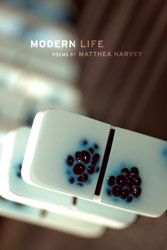
Modern Life (Matthea Harvey, 2007)
In general, I love Harvey's poetry. However, she was writing her Robo-Boy series while I was taking her course at Sarah Lawrence, and at the time I wasn't fond of them at all. In Modern Life, however, I see them as the transition between her older, more sentimental poetry and the new, harsher pieces. Her form tends to get in the way a bit at times ("The Future of Terror" and "Terror of the Future," not actually abecedarian, but still irksome, stand out), and I think that distracts from her ideas and surprises, which I always thought was the strongest part of her work. I think I'm also moving on from her work a bit and appreciating a different sort of poetry than I used to, so that might contribute to my negative feelings.

The Road (Cormac McCarthy, 2006)
I felt like there were an awful lot of connections between this book and Modern Life, but probably only because I'd read one right after the other. The Road's greatest strength is its language, which reads at times like poetry. McCarthy manages to create beauty in his language in all the places where he cannot create it in his bleak landscape. By the end, it felt like a hopeless and much less stark version of The Old Man and the Sea. The ends to each section were generally lovely and moving, and the book is a ridiculously quick read, but I think I'd rather be reading The Old Man and the Sea, which is saying a lot, because I really hated that book in high school.